If you live with hay fever, you already know the feeling: two days that look almost the same from your window, yet one leaves you streaming and the other barely registers. It is not in your head, and it is not that you are "getting worse". Day-to-day hay fever swings are normal, and once you understand what is driving them, the pattern starts to make sense — and becomes a little easier to plan around.
Here is the plain-English version of what changes from one day to the next, drawn from the UK's most trusted sources.
It is rarely just "the pollen count"
The national pollen count is a helpful headline, but it describes a wide region, not the air right outside your door. How you actually feel on a given day depends on several things stacking up together: which pollen is in the air, how much of it, the weather moving it around, the time of day you are outside, and your own sensitivity — which itself shifts across a season. Think of it less as a single number and more as a personal picture that changes daily.
The weather does most of the heavy lifting
Weather is the biggest reason one day feels so different from the last. According to the Met Office, the days that tend to hit hardest are warm, dry and breezy. Warmth and sunshine encourage plants to release more pollen, dry air keeps those grains aloft, and a gentle breeze carries them further and keeps them airborne for longer. Put simply: more pollen, spread more widely, for more of the day.
Rain usually does the opposite. A good downpour washes pollen out of the air and can bring welcome relief — cooler, damper, calmer conditions tend to lower the amount you breathe in. Still, humid and muggy days are not always a break: on close, windless days pollen can hang around near where it was released, and a cool, humid night can let grains settle back down to nose height by morning.
So does rain always help hay fever?
Mostly, yes — steady rain tends to clear the air, at least for a while. But it is not a guarantee, and heavy thunderstorms can do the reverse (more on that below). The relief also tends to be temporary: once things dry out and warm up again, counts climb back.
The time of day matters more than people expect
Pollen is not released at a steady rate around the clock. Levels typically rise through the morning as the day warms and plants release their pollen, and on warm, sunny days there is often a second peak in the early evening as air that lifted pollen high during the day cools and brings it back down. Overnight, cooler temperatures and higher humidity usually let pollen settle, so the very early morning can be lower — one reason some people find a dawn walk gentler than a mid-morning or after-work one.
Which pollen is actually in the air right now
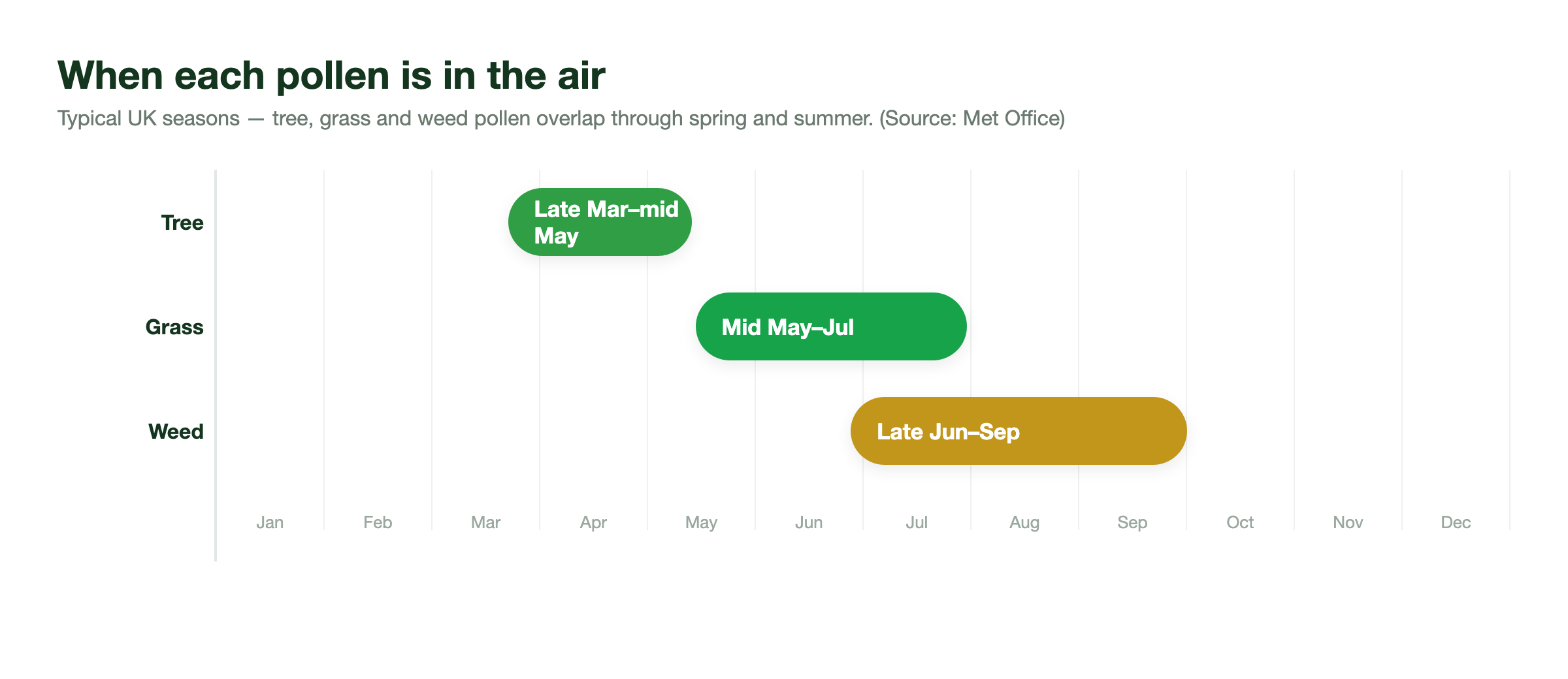
"Hay fever" is really three overlapping seasons, and you may be sensitive to one, two or all three. The Met Office gives these rough UK windows in its guide to when hay fever season runs:
- Tree pollen — typically late March to mid-May (birch is a common trigger).
- Grass pollen — mid-May until July, and the one that affects the most people. It usually has two peaks: the first two weeks of June, then a smaller second peak in the first two weeks of July.
- Weed pollen — from around the end of June into September.
This is why your worst weeks can differ from a friend's: if you react to grass but not tree pollen, June may floor you while their spring was the hard part. Where you live matters too — the season generally starts later and is shorter in the north, and countryside and inland areas tend to see higher counts than towns and the coast.
Thunderstorms: the surprising spike
It seems back-to-front, but a summer thunderstorm can make symptoms suddenly worse rather than better. The moisture and gusts around a storm can burst pollen grains into much smaller fragments. These tiny particles stay airborne and can be breathed deeper into the airways than a whole grain, which is why some people notice a sharp flare during or just after a storm. In people with asthma this can trigger a serious episode sometimes called "thunderstorm asthma". If you have asthma as well as hay fever, it is worth being especially prepared when storms are forecast, and following your personal asthma plan.
Why your own threshold moves during the season
Your body is part of the equation too. After days of heavy exposure, the lining of your nose and eyes can become "primed" and more reactive, so a moderate day late in a bad week can feel worse than a high day at the start. Other everyday things — a poor night's sleep, other allergens indoors, or general tiredness — can lower your tolerance as well. So the same pollen count really can feel different to the same person from one week to the next.
How seeing your own pattern helps
Because so many factors stack up, a regional number on its own rarely tells you how your day will go. That is the idea behind PEPA: it brings together the pollen types, the local weather, the surroundings near you and your own logged history to build a more personal daily picture, so "some days are just worse" slowly turns into "I can see why today is a higher day for me." Over a few weeks, a simple daily note of how you felt — alongside the conditions — is often the quickest way to spot your own triggers and the times of day that suit you best.
None of this replaces good habits: keeping windows shut at peak times, changing clothes and rinsing pollen off after being outside, and using any treatments your pharmacist or GP has suggested, consistently rather than only on bad days.
The takeaway
Your hay fever is worse on some days because several dials are turning at once — the pollen in season, how much is released, the weather carrying it, the time of day, and your own shifting sensitivity. Warm, dry, breezy days and thunderstorms tend to be the hardest; steady rain and cooler, calmer spells often bring relief. Understanding those dials will not stop hay fever, but it does make it far more predictable — and predictable is a lot easier to live with.
This article is general information, not medical advice. Hay fever is usually manageable, but if your symptoms are persistent, severe, affecting your sleep or daily life, or if you also have asthma, please speak to a pharmacist or your GP. For trusted guidance see the NHS hay fever page and Allergy UK.