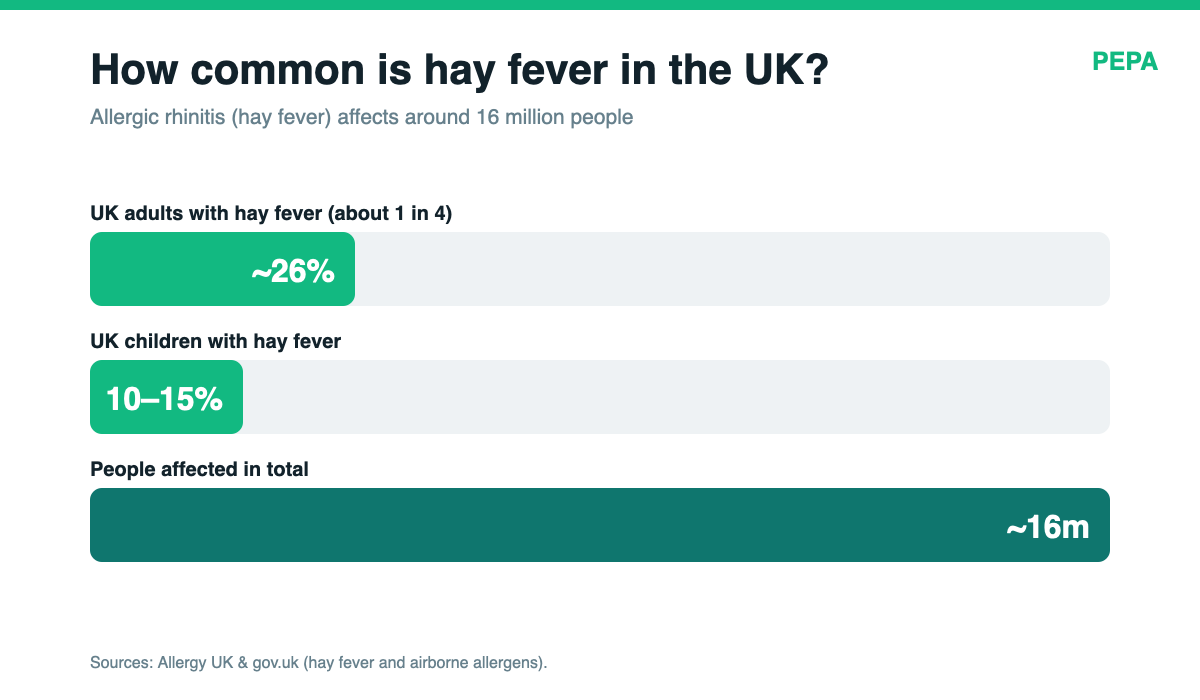
How common is hay fever in the UK? More common than most people realise. Allergic rhinitis — the medical name for hay fever — affects around 1 in 4 adults and about 1 in 8 children, which adds up to roughly 16 million people across the country. If you find yourself sneezing through a warm afternoon while everyone else seems fine, it can feel a little isolating. The numbers tell a kinder story: you are in very good company.
This guide keeps things calm and clear. It looks at how widespread hay fever really is, how the picture differs between adults and children, and why cases seem to have grown so much over the years. There is nothing to sign up for and no reason to worry — just a gentle, honest look at the everyday scale of hay fever in the UK, and what that might mean for your own season.
Key facts at a glance
- Hay fever affects around 26% of UK adults — roughly 1 in 4 (Allergy UK).
- It affects an estimated 10 to 15% of children — about 1 in 8 (Allergy UK).
- Altogether that is around 16 million people in the UK living with hay fever (Allergy UK).
- Cases have roughly trebled over the last 20 years (Allergy UK).
- Symptoms are usually worst between late March and September, and worse on warm, humid, windy days (NHS, gov.uk).
- There is no lasting fix for hay fever, but a pharmacist can suggest gentle ways to ease it (NHS).
Just how common is it?
The simplest way to picture it is this: look around a busy bus, a classroom or an office, and roughly one in four of the adults there will know the itchy eyes and endless sneezing of hay fever. Allergy UK puts the figure at around 26% of UK adults. That is not a rare quirk — it is one of the most common allergic conditions in the country.
Across the whole population, adults and children together, the total comes to about 16 million people. That is a genuinely large number: enough to fill a good many cities over. When the pollen count climbs on a bright June morning, millions of people are reaching for a tissue at the same time, quietly getting on with their day.
Seen that way, hay fever is less a personal misfortune and more a shared feature of the British summer. Knowing the scale of it can be oddly reassuring. If a warm, breezy week leaves you streaming and tired, you are experiencing something that millions of others are feeling in the very same hours.
Adults vs children
The numbers are not the same for every age group. Among adults, Allergy UK estimates that around 26% are affected — roughly one in four. Among children the figure is lower, at an estimated 10 to 15%, which works out at about one in eight. So while children can and do get hay fever, it becomes noticeably more common as people move into adulthood.
There are a few gentle reasons behind the gap. Hay fever often appears for the first time in childhood or the teenage years, but plenty of people find it develops later, in their twenties or beyond. Others notice it easing as they get older. Because everyone's pattern is a little different, the age figures are a broad picture rather than a fixed rule for any one person.
For families, the practical upshot is simple and calm. If a child seems to sneeze and rub their eyes every spring and summer, they are far from alone — roughly one in eight children shares that experience. And if hay fever seems to run in a family, that is common too, as allergic tendencies often appear across more than one generation.
Why hay fever seems to be getting more common
One of the more striking figures from Allergy UK is that cases have roughly trebled over the last 20 years. That is a real change within a single generation, and it is worth looking at gently rather than with alarm. More people noticing hay fever does not mean the season itself has become something to fear.
Researchers point to several threads woven together. Greater awareness means more people recognise their symptoms as hay fever rather than a lingering cold. Changes in where and how we live, and in the air around us, may play a part too. The overall message is not that hay fever has become more severe, but that it now touches more people than it once did.
Whatever the causes, the everyday reality is steady and manageable. Hay fever remains a well-understood, everyday condition, and the gentle habits that help have not changed. If anything, the rising numbers are a reminder of just how ordinary and shared the experience has become.

What it means for you
The headline is a comforting one: you are not alone. With around 1 in 4 adults and about 1 in 8 children affected, most friendship groups, workplaces and families include at least one person who knows exactly what a high-pollen day feels like. Whatever you are experiencing, someone close by almost certainly understands it.
Knowing the scale can also take a little of the frustration out of the season. Hay fever is not a sign that anything is wrong with you; it is simply a very common way of reacting to pollen. That shift in framing — from something to battle to something to understand — often makes the summer feel a good deal calmer.
The most useful thing you can do is learn your own pattern within the wider picture. The national figures tell you how common hay fever is; your own notes tell you which weeks, which weather and which type of pollen tend to affect you most. Over a season or two, that personal knowledge becomes far more helpful than any statistic.
What you can do
A few small, gentle habits can ease a higher-pollen day. Many people start by checking the local pollen forecast, so they know roughly what the air holds before heading out. On the busiest days, keeping windows shut at peak times and drying washing indoors can keep a little more pollen outside where it belongs.
When you are out and about, wraparound sunglasses help shield your eyes, and rinsing your face or changing your top after being outside means you carry less pollen home with you. Leaving shoes and outer layers by the door, and wiping pets down after a walk, keeps a bit more of it outdoors too. None of this is a cast-iron rule; they are simply kind, low-effort routines that many people find make a difference.
If hay fever is disrupting your daily life — your sleep, your work, your enjoyment of being outside — a pharmacist is a good first port of call. They can talk through what you are experiencing and suggest gentle ways to ease it. See a GP if symptoms are severe, do not improve, or you are worried, especially for very young children or anyone with a long-term condition.
In short
So, how common is hay fever in the UK? Around 1 in 4 adults and about 1 in 8 children are affected — roughly 16 million people in all — and cases have trebled over the last 20 years. Symptoms tend to be worst between late March and September, and worse on warm, humid, windy days. If it ever feels like just you against the pollen, the numbers are a quiet reminder that millions of others are right there with you.
PEPA shares general information to help you understand the everyday picture. It is not medical advice and does not replace a conversation with a pharmacist, GP or the NHS. If your symptoms are getting in the way of daily life, or something feels wrong, please check in with them.
If you would like a calm, local view of the pollen where you actually are — and a simple way to note how you feel over time — PEPA is there to help, with no account to set up and nothing to share. Many people find it a gentle way to spot their own pattern within the bigger picture.
PEPA is free on the App Store: https://apps.apple.com/gb/app/pepa/id6789877854
Frequently asked questions
How common is hay fever in the UK?
Hay fever is very common. Allergy UK estimates that around 26% of UK adults are affected — roughly 1 in 4 — along with an estimated 10 to 15% of children, or about 1 in 8. Altogether that comes to around 16 million people across the UK, making it one of the most common allergic conditions in the country.
How many people in the UK have hay fever?
Roughly 16 million people in the UK are estimated to have hay fever, according to Allergy UK. That figure combines the adults affected — around 1 in 4 — with the children affected, at about 1 in 8. It is a large, everyday number, which is part of why hay fever feels like such a familiar feature of the British spring and summer.
Is hay fever more common in adults or children?
It is more common in adults. Allergy UK estimates around 26% of adults are affected, compared with an estimated 10 to 15% of children. Hay fever often first appears in childhood or the teenage years, but many people find it develops later in life, and some notice it easing as they get older.
Is hay fever becoming more common?
Yes. Allergy UK reports that cases have roughly trebled over the last 20 years. Greater awareness, changes in how and where we live, and shifts in the air around us are among the threads researchers point to. It is a real change, though a calm one — hay fever remains a well-understood, everyday condition.
When is hay fever usually at its worst?
Symptoms are usually worst between late March and September, and tend to be worse on warm, humid and windy days, when the pollen count is at its highest, according to the NHS and gov.uk. The exact timing depends on which pollen affects you — tree pollen earlier in spring, grass pollen through early summer, and weed pollen into autumn.
Read next
References
- Hay fever (allergic rhinitis) affects around 26% of UK adults and an estimated 10 to 15% of children — roughly 1 in 4 adults and about 1 in 8 children, adding up to around 16 million people in the UK. — Allergy UK, Statistics and figures. Source (checked 2026-07-27).
- Cases of hay fever have roughly trebled over the last 20 years. — Allergy UK, Statistics and figures. Source (checked 2026-07-27).
- Hay fever symptoms are usually worse between late March and September, especially when it is warm, humid and windy, and there is no lasting fix, though a pharmacist can give advice to help ease the symptoms. — NHS, Hay fever. Source (checked 2026-07-27).
- Hay fever is caused by an allergy to airborne pollen, and symptoms are worst when the pollen count is high, typically on warm, humid and windy days across the pollen season. — gov.uk, Hay fever and airborne allergens. Source (checked 2026-07-27).
Image credits
- Photo by kaboompics.com on Pexels.
- Photo by Keira Burton on Pexels.
PEPA shares general lifestyle information only. It is not medical advice, and it does not replace guidance from a pharmacist or GP. Please speak to them about your symptoms or any health concerns.