If you are wondering when hay fever season is in the UK, the short answer is that it usually runs from late March right through to September, depending on which pollen affects you. Tree pollen comes first in spring, grass pollen takes over in early summer, and weed pollen carries on into the autumn. So the hay fever season is not one single stretch but three overlapping ones, and the weeks that trouble you most depend on which of those pollens you happen to react to.
This guide keeps things calm and clear. There is no need to memorise dates or feel you must get it exactly right — the aim is simply to help you understand the shape of the year, work out roughly when your own symptoms are likely to appear, and feel a little more prepared. If you only ever notice a runny nose in June, or you struggle from the first warm days of spring, the pollen calendar below will help explain why.
Key facts at a glance
- Tree pollen is usually in the air from late March to mid-May and affects around 25% of people with hay fever (Met Office).
- Grass pollen typically runs from mid-May to July and affects the majority of hay fever sufferers (Met Office).
- Weed pollen tends to appear from late June to September (Met Office).
- Hay fever symptoms are usually worst when it is warm, humid and windy (NHS).
- Hay fever can last weeks or months while pollen is high, whereas a cold usually clears in 1 to 2 weeks (NHS).
- The seasons shift a little year to year and tend to start later and be shorter in the north of the UK (Met Office).
The three pollen seasons
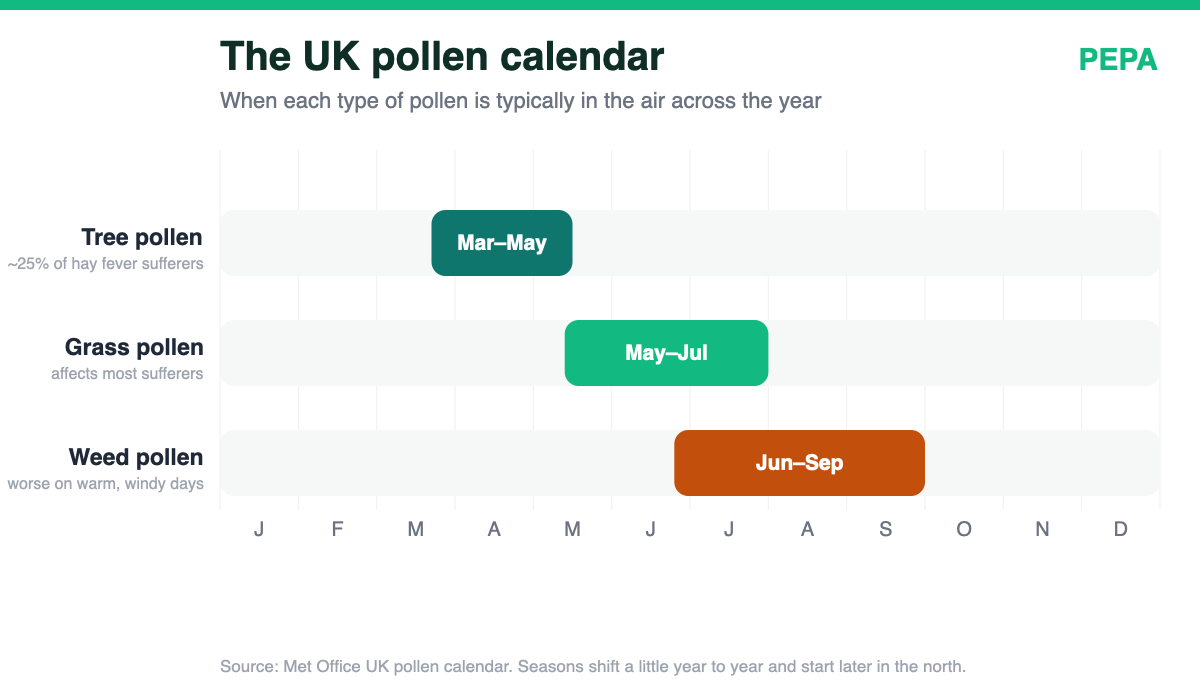
The simplest way to picture hay fever season is as three pollens taking their turn through the year. Each one has its own rough window, and each affects a different share of people, which is why two neighbours can have very different experiences of the same summer.
| Pollen type | Typical UK season | Who it affects |
|---|---|---|
| Tree | Late March to mid-May | Around 25% of sufferers |
| Grass | Mid-May to July | Most sufferers |
| Weed | Late June to September | Fewer, but a long tail into autumn |
This table is drawn from the Met Office pollen calendar, which sets out the typical windows for tree, grass and weed pollen across the UK. Read the dates as gentle guides rather than fixed lines: the weather each year nudges them earlier or later, and where you live in the country makes a difference too.
Tree pollen season (late March to mid-May)
Tree pollen is the first to arrive, usually from late March and easing off around the middle of May. It affects around a quarter of people with hay fever, so if your symptoms show up on the first bright, breezy days of spring — well before the grass has grown — trees are the likely cause.
Because it comes so early, tree pollen sometimes catches people out. You might notice sneezing or itchy eyes on a mild March afternoon and assume it is a lingering cold. If that pattern repeats each spring, and lifts by early summer, it points gently towards a tree-pollen sensitivity rather than anything else.
Grass pollen season (mid-May to July)
Grass pollen is the one most people mean when they talk about hay fever. It usually runs from mid-May into July and affects the majority of sufferers, which makes this stretch the peak hay fever season for most people in the UK. If your worst weeks land in June, grass is almost certainly the reason.
This is the main summer trigger, and it often overlaps the tail of the tree season and the start of the weed season, so early summer can feel like the busiest time of all. For many people, once the grass pollen settles down in July, the hardest part of their year is behind them.
Weed pollen season (late June to September)
Weed pollen — from plants such as nettles and docks — tends to appear from late June and can carry on until September. Fewer people react to it than to grass, but for those who do, it gives hay fever a long tail into the late summer and early autumn, well after the grass has faded.
If you find your symptoms easing in July only to return in August or September, weed pollen may be the explanation. It is the reason some people think of hay fever as an autumn problem as much as a summer one, and why the season as a whole stretches so far across the year.
Why your season may differ
The dates above are a national guide, and your own season can sit a little differently. If you live in the north of the UK, the Met Office notes that pollen seasons tend to start later and be shorter than in the south, so your worst weeks may arrive a touch later in the year.

Weather matters too. Hay fever is usually at its worst when it is warm, humid and windy, because those conditions lift pollen into the air and carry it around; a spell of rain often clears the air and brings a welcome pause. And of course, your own trigger matters most of all — whether you react to tree, grass or weed pollen shapes exactly which weeks feel hardest. Keeping a simple day-by-day note over a season is the surest way to reveal your personal pattern.
What you can do this season
Once you know roughly when your season falls, a few gentle habits make the higher-pollen days easier. None of this is about doing everything perfectly — it is about small, calm routines that add up when the count is climbing.
You might start by checking the local pollen count so you know what kind of day to expect. On the busiest days, keeping windows shut at peak times, wearing wraparound sunglasses outdoors, and rinsing your face or changing your top after being out all help you carry less pollen around with you. Drying washing indoors when levels are high keeps pollen off your clothes and sheets. And if the count is low, or rain has cleared the air, those are the days to enjoy being outside. There is no need to hide away for a whole season — just to lean into the gentler days and take a little more care on the harder ones.
In short
Hay fever season in the UK runs broadly from late March to September, split across three overlapping pollens: tree from late March to mid-May, grass from mid-May to July, and weed from late June to September. Grass is the main summer trigger for most people, while the season starts later and is shorter in the north. Knowing which pollen affects you, and watching the local count, is the calmest way to plan the weeks ahead.
Whenever you are ready, PEPA offers a quiet, local view of the day's pollen where you actually are, and a simple place to note how you feel over time. Many people find it a gentle way to learn their own pattern across the season — with no account to set up and nothing to share.
Frequently asked questions
When does hay fever season start and end in the UK?
Hay fever season usually begins in late March, when tree pollen first appears, and runs through to September, when the weed pollen season finally fades. Grass pollen fills the middle of that stretch. The exact start and end shift a little each year with the weather, and tend to arrive later in the north of the UK.
Which months are worst for hay fever?
For most people the worst months are late May, June and July, when grass pollen — the trigger that affects the majority of sufferers — is at its height. If you react to tree pollen, your hardest weeks may come earlier, in April and early May; if weed pollen affects you, August and September can be trickier.
Why is grass pollen the worst for most people?
Grass pollen affects the majority of people with hay fever, more than tree or weed pollen, which is simply why it causes the most trouble overall. It is also in the air across the warm early-summer weeks when many of us want to be outdoors, so exposure tends to be high just when the count is climbing.
Does hay fever season change each year?
Yes, a little. The Met Office notes that the seasons shift from year to year depending on the weather, so a warm early spring can bring tree pollen forward, and a cool, wet spell can hold things back. Where you live matters too, with northern parts of the UK generally seeing a later, shorter season.
How long does hay fever last compared with a cold?
Hay fever can last for weeks or months, for as long as the pollen you react to is in the air, whereas a cold usually clears within 1 to 2 weeks. If sneezing and a runny nose stretch on through a warm, dry spell in the pollen season, hay fever is the more likely cause.
PEPA shares general information to help you understand the everyday picture. It is not medical advice and does not replace a conversation with a pharmacist, GP or the NHS. If your symptoms are persistent, uncomfortable or getting in the way of daily life, a pharmacist is a good first port of call, and they can suggest simple ways to ease them.
Read next
References
- Hay fever symptoms are usually worst when it is warm, humid and windy; hay fever can last for weeks or months, unlike a cold, which usually goes away after 1 to 2 weeks, and there is no cure, though a pharmacist can suggest ways to ease it. — NHS, Hay fever. Source (checked 2026-07-25).
- In the UK, tree pollen season typically runs from late March to mid-May, grass pollen from mid-May to July, and weed pollen from the end of June to September; the seasons shift a little year to year and tend to start later and be shorter in the north of the UK. — Met Office, When is hay fever season. Source (checked 2026-07-25).
- Tree pollen affects around 25% of people with hay fever, while grass pollen affects the majority of sufferers. — Met Office, What are the different types of pollen. Source (checked 2026-07-25).
Image credits
- Photo by Negative Space on Pexels.
- Photo by Gustavo Fring on Pexels.
PEPA shares general lifestyle information only. It is not medical advice, and it does not replace guidance from a pharmacist or GP. Please speak to them about your symptoms or any health concerns.