
Can hay fever affect your exams and your grades? For many students the honest answer is yes — and there is real research behind it. A large UK study found that teenagers with hay fever symptoms during the exam period were noticeably more likely to slip a grade between their mock and final GCSE exams. That is why hay fever and exams are worth thinking about together, gently and early, rather than as a surprise in the middle of June.
None of this is meant to worry anyone. The point is simply that summer exams and peak pollen land at the same time of year, and the runny nose, itchy eyes and broken sleep that come with hay fever can chip away at concentration when you most want to feel sharp. This guide walks through what the research actually found, why exam season overlaps so neatly with pollen season, and the calm, everyday things students and parents can do to make revision a little easier.
Key facts at a glance
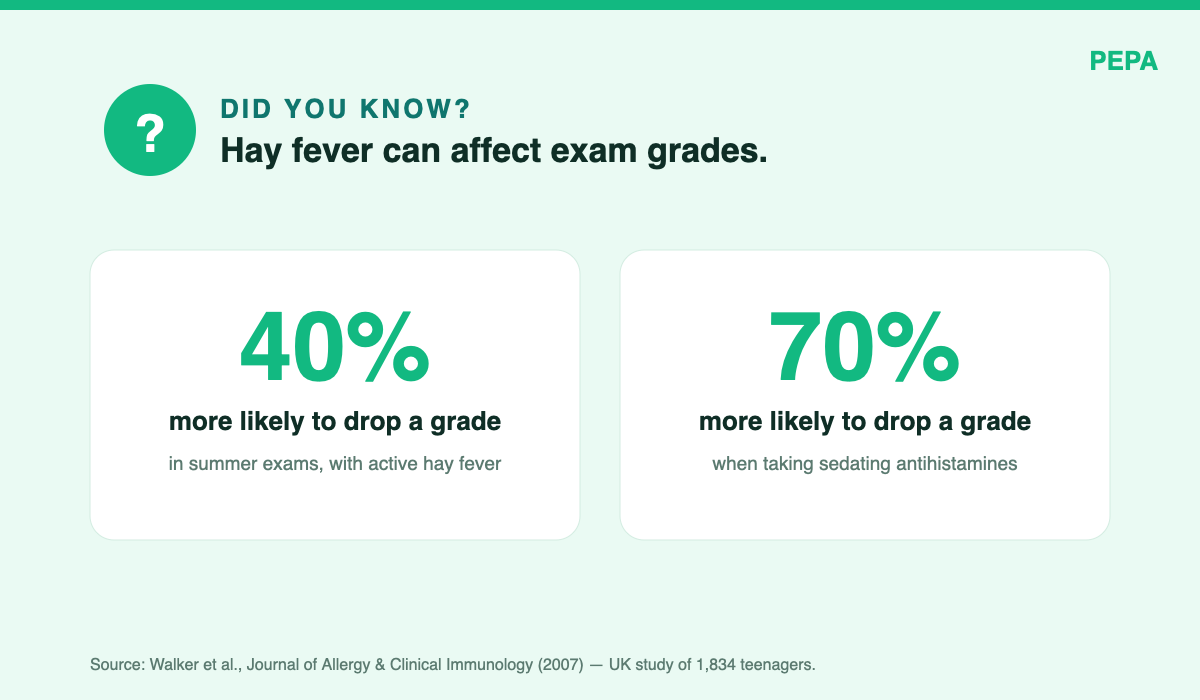
- A UK study of 1,834 teenagers found students with hay fever symptoms during the exam period were about 40% more likely to drop a grade between mock and final GCSE exams (Walker et al., Journal of Allergy and Clinical Immunology, 2007).
- That risk rose to about 70% more likely among students who were using sedating antihistamines during the exam period (Walker et al., 2007).
- Summer GCSE and A-level exams (roughly May to June) fall inside the UK's peak grass pollen season, which runs from mid-May to July (Met Office).
- Grass pollen is the main trigger for most people with hay fever (Met Office, NHS).
- Hay fever can cause daytime tiredness, poor sleep and reduced concentration — exactly the things you rely on when revising (NHS).
- There is no lasting fix for hay fever, but a pharmacist can talk through options that may suit you (NHS).
Why exam season is peak hay fever season
The timing is unlucky, and it is no coincidence that so many students notice their symptoms flaring just as revision ramps up. In the UK, the main GCSE and A-level written exams sit across May and June. According to the Met Office, grass pollen season runs from mid-May to July — so the busiest weeks of the exam calendar land squarely inside the busiest weeks for grass pollen.
Grass pollen matters here because it is the trigger for most people who get hay fever. Tree pollen arrives earlier in spring, and weed pollen lingers into autumn, but it is grass that dominates early summer, precisely when exam halls are at their fullest. On a warm, dry, breezy afternoon — classic revision weather — the pollen count can climb, and symptoms tend to climb with it.
That overlap is the whole reason hay fever and exams are worth planning around. If you know that your worst pollen weeks are also your most important revision weeks, you can build a few gentle habits in advance rather than reacting once your eyes are already streaming and your sleep is already broken.
What the research found
The clearest evidence comes from a UK case-control study by Walker and colleagues, published in the Journal of Allergy and Clinical Immunology in 2007. The researchers followed 1,834 teenagers through their GCSE year and compared how each student performed in their mock exams (usually sat in winter, away from pollen) with their final summer exams (sat during peak grass pollen).
They found that students who had hay fever symptoms on an exam day were about 40% more likely to drop a grade between their mocks and their finals than students without symptoms. In other words, a teenager on track for a particular grade in the calm of winter was measurably more likely to come out a grade lower once summer pollen arrived.
The study also looked at what students were using to manage their symptoms, and this is the part worth reading carefully. Among students who were using a sedating (drowsy) antihistamine during the exam period, the likelihood of dropping a grade rose to about 70%. The researchers suggested that the drowsiness itself — on top of the hay fever — may have added to the effect, which is a gentle reminder that not all options feel the same when you need to concentrate.
It is important to keep this in proportion. The study points to an association across a large group of students, not a certainty for any one person, and it does not mean anyone is destined to do worse. What it does highlight is a practical, factual point: sedating and non-drowsy antihistamines can feel very different during study and exams. This is not medical advice and PEPA does not recommend any specific product, but a pharmacist can advise which options may suit you and your day.
How hay fever gets in the way
You do not need a study to know how draining a bad hay fever day can feel, but it helps to name exactly what gets in the way. The NHS notes that hay fever can bring daytime tiredness, disturbed sleep and reduced concentration — a combination that lands especially hard when you are trying to revise or sit still through a long paper.
Poor sleep is often the quiet culprit. A blocked, itchy, runny nose makes it harder to drop off and harder to stay asleep, so you wake already behind on rest. Carry that tiredness into a morning of revision and your focus fades faster, your reading slows, and information is harder to hold on to. None of it is dramatic on its own; it just quietly stacks up over a run of days.
Then there is the in-the-moment distraction. Itchy eyes, repeated sneezing and a streaming nose pull your attention away from the page or the exam question in front of you. For a subject that rewards sustained concentration, those small interruptions add up across a two- or three-hour paper. Understanding this is the first, calming step — because most of it can be softened with a few simple routines.

What students (and parents) can do
The good news is that a handful of gentle habits can take the edge off a high-pollen day, and none of them require anything dramatic. The idea is simply to meet less pollen, sleep a little better, and plan revision around the calmer times of day.
- Check the local pollen count. Glancing at the day's grass pollen level lets you plan around it — heavier revision indoors on high days, and outdoor breaks when levels are lower.
- Revise indoors with the windows shut at peak times. Grass pollen is often highest in the early morning and again in the early evening, so keeping windows closed then keeps more of it outside.
- Wear wraparound sunglasses outside. They are a small, easy way to keep pollen out of your eyes on the walk to school or a study break.
- Shower and change after being outdoors. Pollen clings to hair, skin and clothes, so rinsing off and changing your top means you carry less of it back to your desk and your pillow.
- Plan outdoor breaks for lower-pollen times. If you can, take fresh-air breaks after rain or later in the day, when the count often eases.
- Speak to a pharmacist early. A pharmacist can talk through the options and advise which non-drowsy choices may suit you, well before exam week rather than in the middle of it.
For parents, the most useful role is often the calm, practical one: helping keep bedrooms and study spaces low-pollen, encouraging an earlier chat with a pharmacist, and making space for good sleep during the exam run. A settled, well-rested student copes far better with a high-pollen day than a tired, rushed one.
PEPA shares general information to help you understand the everyday picture of hay fever and exams. It is not medical advice and does not replace a conversation with a pharmacist, GP or the NHS. Never start, stop or change any medication based on an article — a pharmacist or GP can advise on what is right for you.
In short
Hay fever and exams overlap because summer's biggest exams fall inside peak grass pollen season. A UK study of 1,834 teenagers found that students with hay fever symptoms during the exam period were about 40% more likely to drop a grade, rising to about 70% among those using sedating antihistamines. Hay fever's tiredness, poor sleep and reduced concentration are the mechanisms behind that. None of it is fixed in advance: checking the pollen count, revising indoors at peak times, keeping pollen off your face and pillow, and speaking to a pharmacist early can all help you feel a little more like yourself when it matters.
Whatever your revision looks like this year, a calmer, better-informed pollen season is well within reach — one gentle habit at a time. PEPA is here to give you a simple, local view of the day ahead so you can plan around it without fuss.
PEPA is free on the App Store: https://apps.apple.com/gb/app/pepa/id6789877854
Frequently asked questions
Can hay fever really affect exam grades?
Research suggests it can. A UK study of 1,834 teenagers found students with hay fever symptoms during the exam period were about 40% more likely to drop a grade between their mock and final GCSE exams. It reflects a pattern across a large group, not a certainty for any one student, and gentle habits can help.
Why do hay fever and exams clash every summer?
Because the timing overlaps. The main GCSE and A-level exams fall across May and June, while the UK's peak grass pollen season runs from mid-May to July, according to the Met Office. Grass pollen is the main trigger for most people, so the busiest exam weeks land inside the busiest pollen weeks.
Do sedating antihistamines affect concentration during exams?
In the same UK study, students using a sedating (drowsy) antihistamine during the exam period were about 70% more likely to drop a grade. Sedating and non-drowsy options can feel very different when you need to focus. A pharmacist can advise which options may suit you — this is general information, not medical advice.
How does hay fever make revision harder?
The NHS notes that hay fever can cause daytime tiredness, disturbed sleep and reduced concentration. Broken sleep leaves you starting the day behind on rest, while itchy eyes and sneezing pull your attention away from the page. Together they can quietly wear down focus over a run of revision days.
What can students do to cope with hay fever during exams?
Small, calm habits help most: check the local pollen count, revise indoors with windows shut at peak times, wear wraparound sunglasses outside, shower and change after being out, and plan outdoor breaks for lower-pollen times. Speaking to a pharmacist early about non-drowsy options is worth doing before exam week.
Read next
References
- A UK case-control study of 1,834 teenagers found students with hay fever symptoms during the exam period were about 40% more likely to drop a grade between their mock and final GCSE exams, rising to about 70% among those using sedating antihistamines. — Walker et al., Journal of Allergy and Clinical Immunology. Source (checked 2026-07-27).
- Hay fever can cause daytime tiredness, disturbed sleep and reduced concentration, and there is no lasting fix, though a pharmacist can advise on ways to ease symptoms. — NHS, Hay fever. Source (checked 2026-07-27).
- In the UK, grass pollen season runs from mid-May to July, and grass pollen is the trigger for most people with hay fever. — Met Office, When is hay fever season. Source (checked 2026-07-27).
Image credits
- Photo by kaboompics.com on Pexels.
- Photo by Gera Cejas on Pexels.
PEPA shares general lifestyle information only. It is not medical advice, and it does not replace guidance from a pharmacist or GP. Please speak to them about your symptoms or any health concerns.